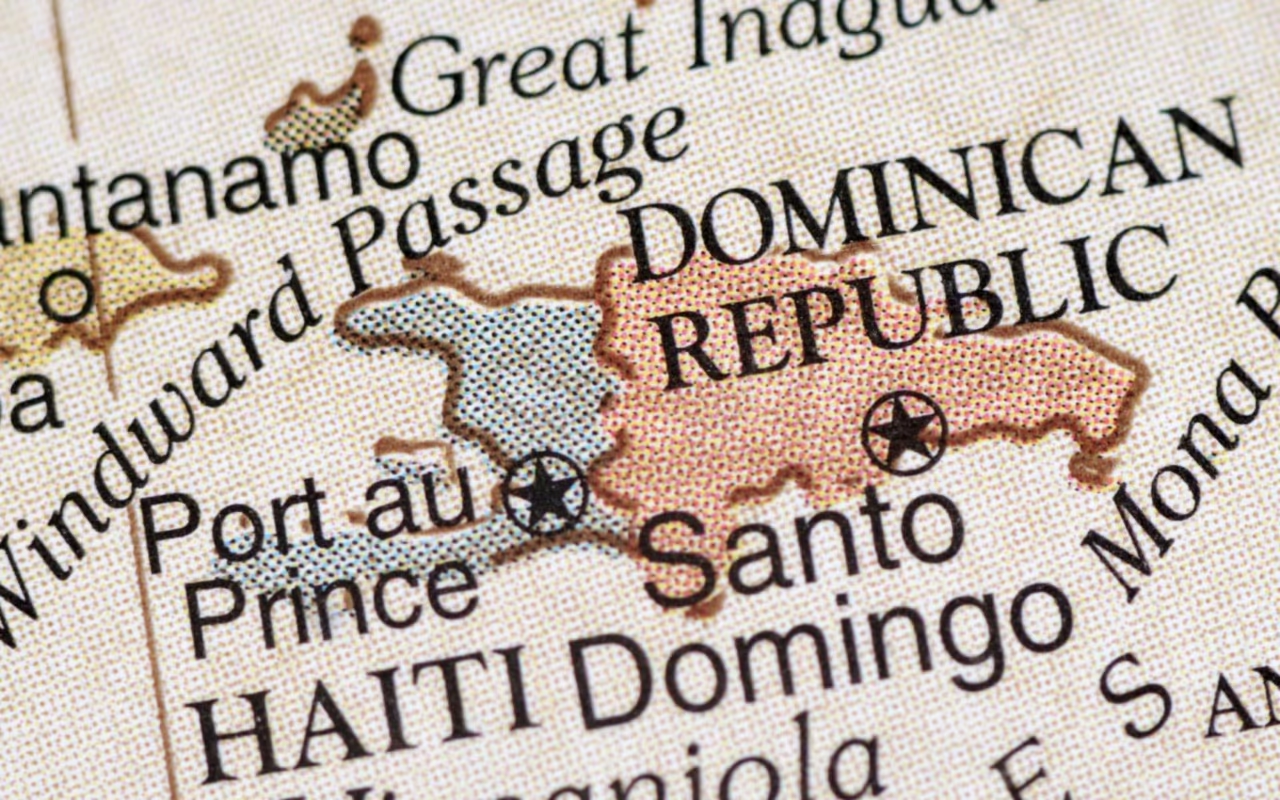
The history of the Dominican Republic is one of the most fascinating in the Americas. As the first European colony in the New World, it served as a testing ground for the colonization of the continent. It still bears the marks of this history today: in its architecture, language, music, and national identity.
Understanding colonization, the Dominican Republic’s independence in 1844, and the major political periods provides a better understanding of the country’s spirit. For an overview of what the country is like today, check out our article “The Dominican Republic at a Glance.”
Before 1492: The Taíno Civilization on Hispaniola
Before the arrival of Europeans, the island of Hispaniola was inhabited by the Taíno, an Arawak people who had lived there for over a millennium. Taíno society was divided into cacicazgos (chiefdoms) led by caciques. The island was organized into five major kingdoms: Higüey, Marién, Magua, Xaragua, and Maguana.
The Taíno people subsisted on a diverse agricultural economy (cassava, corn, sweet potatoes), fishing, and elaborate handicrafts. Their villages were organized around circular bohíos and a ceremonial space called a batey. They believed in deities such as Yukiyú and Juracán (from which the word “hurricane” derives).
The arrival of Christopher Columbus in December 1492 marked a sudden turning point. Imported diseases, theencomienda system, and forced labor led to a massive population collapse. In less than half a century, the Taíno population had almost completely disappeared. Yet their legacy lives on in place names, cuisine, and certain folk traditions. To learn more about this living legacy, explore our article “Dominican Terroirs & Craftsmanship.”
1492: Spanish Colonization and the Birth of the New World
Christopher Columbus landed on the island he named Hispaniola in December 1492. He had just paved the way for European colonization of the Americas. The fort at La Navidad was the first European settlement on the continent.
Santo Domingo: First Capital of the Americas
Officially founded in 1498, Santo Domingo became the first European capital on the American continent. The first cathedral in the Americas, the first hospital, and the first university in the New World were built there. The economy relied initially on gold, then on sugarcane and tobacco. Following the mass disappearance of the Taínos, the colonists imported African slaves, laying the foundation for Dominican racial mixing.
The Division of Hispaniola: Spain and France
In the 17th century, France established a presence in the western part of the island. The Treaty of Ryswick (1697) formalized the division: Saint-Domingue (later Haiti) to the west, and Santo Domingo (later the Dominican Republic) to the east. This separation explains why two different countries now share the same island.
1844: Independence of the Dominican Republic
In 1822, Haitian President Jean-Pierre Boyer unified the entire island under Haitian administration. Underground movements emerged, including La Trinitaria, founded in 1838 by Juan Pablo Duarte, which worked toward independence.
On February 27, 1844, Ramón Matías Mella fired a symbolic cannon shot at the Puerta del Conde in Santo Domingo. Francisco del Rosario Sánchez read the declaration of independence, and the new Dominican flag was raised. This is the country’s national holiday, celebrated with great enthusiasm every year.
Why is it called the “Dominican Republic”?
The country takes its name from Santo Domingo, which itself is named after Saint Dominic. The name literally means “Republic of Santo Domingo.”
The 20th Century: From Dictatorship to Democracy
From 1930 to 1961, Rafael Leónidas Trujillo ruled the country with an authoritarian hand for 31 years. His regime left a deep mark on Dominican history: infrastructure development, but also strict political control and severe repression. After his assassination in 1961, the country went through a period of instability before gradually consolidating its democratic institutions. Today, the Dominican Republic is one of the most dynamic economies in the Caribbean.
Key Dates in Dominican History
| Year | Event |
|---|---|
| 1492 | Christopher Columbus arrives on the island of Hispaniola |
| 1498 | Founding of Santo Domingo, the first European capital in the Americas |
| 1697 | Treaty of Ryswick—division of the island between Spain and France |
| 1822–1844 | Haitian occupation of the eastern part |
| Feb. 27, 1844 | Independence of the Dominican Republic – Juan Pablo Duarte |
| 1863–1865 | War of Restoration: Regaining Sovereignty |
| 1930–1961 | Dictatorship of Rafael Trujillo |
| 1965 | Civil War and Foreign Intervention |
FAQ – History of the Dominican Republic
Who discovered the Dominican Republic?
Christopher Columbus in 1492, during his first transatlantic voyage.
What is the difference between Hispaniola and the Dominican Republic?
Hispaniola is the name of the entire island. The Dominican Republic occupies the eastern part, and Haiti the western part.
When did the Dominican Republic become independent?
February 27, 1844.
Who were the Taíno?
The indigenous peoples of Hispaniola before the arrival of Europeans, whose legacy can still be found in Dominican culture, place names, and cuisine.
Conclusion
The history of the Dominican Republic is one of a clash of worlds, reconstruction, and a unique cultural fusion. Understanding this past means traveling with greater awareness, depth, and respect for Dominican identity.
Want to experience this history firsthand? Explore the history of Santo Domingo, visit Santo Domingo and its Colonial City, or discover the Taino caves and cenotes listed as UNESCO World Heritage Sites.
About the Author
Laura Grenouillet is the founder of Terra Dominicana, a local agency based in Santo Domingo that specializes in customized and immersive travel experiences. She designs cultural and nature-based itineraries that allow travelers to discover the Dominican Republic beyond the typical beach resort circuits.